
Insights & Use Cases
Explore our use cases and insights to learn how optimization can transform your business
Why Process Plants Sign Off an S&OP Plan the Floor Can't Run
Introduction
Every month the S&OP plan gets built, reviewed, signed off. Demand balanced against capacity, numbers reconciled, leadership on board. A good plan. Then the month starts, and within two weeks the floor is running something else.
Nobody decided to abandon it. It just couldn't be run as written, so the schedulers rebuilt it day by day, the way they always do. The plant hit most of the volume, so the plan looked like it worked. It didn't. The schedulers' improvising worked, and the plan everyone signed was a forecast of a plant that doesn't exist.
Two plans that were never going to match
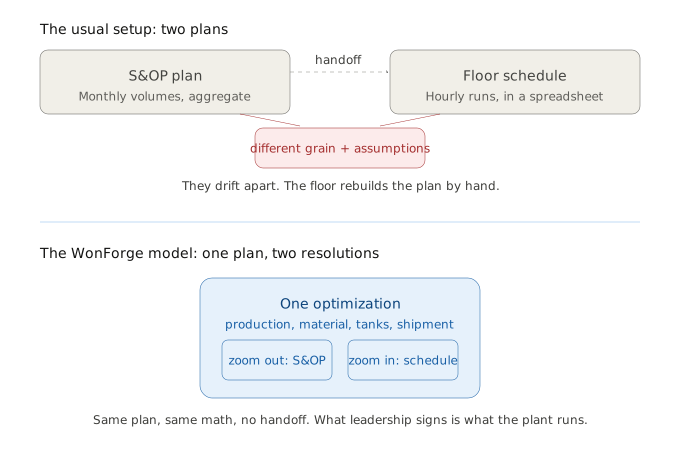
The monthly plan and the daily schedule aren't one plan at two zoom levels. They're two different plans, and almost everything about how they're made pushes them apart.
The S&OP plan says "make 4,000 tons of product B in March." It doesn't say in what order, on which line, after which product, across which changeover. Those decisions, the ones that decide whether 4,000 tons is even possible, get made later, somewhere else, by someone else, usually in a spreadsheet. And they get made against the real physics the monthly plan averaged away: the grade that fouls the line if it runs in the wrong order, the tank still draining, the rate that product actually holds.
So the monthly plan is feasible in the aggregate, where the hard parts disappear into averages. The moment it has to become a sequence of real runs, it stops being executable, and someone fixes it by hand.
S&OP and the schedule are built in different places, on different assumptions, by different people. They were never going to be the same plan.
Why a better S&OP process won't fix it
The usual response is procedural: tighter cadence, better demand inputs, a consensus forecast everyone commits to. All of that sharpens the number. None of it touches the gap, because the gap isn't a communication problem, it's a handoff. You can run a flawless S&OP process and still hand the floor an aggregate number that nobody has checked against the actual sequence. The plan breaks at the handoff, and no amount of process discipline removes the handoff.
Meanwhile the cost leaks quietly, never as one line item. Capacity, because the aggregate plan promised volume the sequenced floor can't deliver. Shared-asset limits, because the S&OP plan treats a month of capacity as one big number and never sees that two products need the same asset in the same week, so the volume it promised was never physically runnable. Trust, because every month the commitment misses in the details and finance, sales, and operations slowly stop believing the plan they all approved.
A better meeting produces a better number. It says nothing about whether that number can actually be run once it hits the floor.
The fix is one plan, not two
The gap closes only when the long-range plan and the floor schedule stop being two documents and become one model at different resolutions. The monthly volumes and the actual run sequence are solved together, so the aggregate plan is built already knowing the changeovers, yields, shared-asset and tank limits, and rates that decide whether it can be executed. Zoom out and it's an S&OP plan. Zoom in and it's a schedule. Same plan, same math, no handoff between them.
That's what WonForge does. One optimization carries the plan from the long-range horizon down to the near-term sequence, with production, material, tank, and shipment limits all inside it. There's no second system that has to discover the plan is impossible, because the physics was in the plan from the start. The number leadership signs is the number the plant runs.
When S&OP and the schedule come out of one model instead of two, the plan you commit to is the plan the floor executes, because they were never separate to begin with.
Frequently Asked Questions
Why do the S&OP plan and the production schedule drift apart every month?
Because they are two different plans built in different places on different assumptions. The S&OP plan commits to aggregate monthly volume; it never specifies the order, line, changeover, and rate that decide whether that volume is physically runnable. Those decisions get made later, by someone else, usually in a spreadsheet, against the real constraints the monthly plan averaged away. The schedule that results is a different plan, so the floor drifts off the signed plan within weeks.
Won't a better S&OP process close the gap?
No. Tighter cadence, better demand inputs, and a consensus forecast sharpen the number, but the gap isn't a communication problem, it's a handoff. You can run a flawless S&OP process and still hand the floor an aggregate number nobody has checked against the actual sequence. The plan breaks at the handoff, and no amount of process discipline removes the handoff.
What does "one plan, not two" actually mean in practice?
It means the long-range volumes and the near-term run sequence are solved together in one model, so the aggregate plan is built already knowing the changeovers, yields, shared-asset and tank limits, and rates that decide whether it can be executed. Zoom out and it's an S&OP plan; zoom in and it's a schedule. One optimization carries production, material, tank, and shipment limits across every horizon, so there's no second system that has to discover the plan is impossible.
Conclusion
A process plant can run a disciplined S&OP process, approve a balanced plan, and still watch the floor walk away from it in two weeks, because the plan and the schedule were built apart and only met after the fact. Aligning them isn't a better meeting. It's making the long-range plan and the daily schedule the same plan, so what leadership signs and what the plant runs are finally one thing.
Related insights
- A Process Manufacturer Can Hit Every Number and Still Lose MarginProcess plants hit tonnage and lose margin. Feed splits into product, co-product, off-spec, and loss by grade and line. Yield, blend, and rate need one plan.
- Custom Optimization is for Process ManufacturingProcess plants need optimization models that solve plant physics, sequence-dependent changeovers, by-products, tank routing, and shelf life inside the math. Why custom optimization fits process manufacturing where configurable templates fall back to Excel.
- Your Allergen Rule and Your Shelf-Life Clock Want Opposite SchedulesAllergen sequencing wants long production runs. Shelf life wants short ones. Why food plants can't satisfy both by hand, and what it costs.
See also: The Shelf-Life Squeeze: How Disconnected Schedules Cause Retailer Rejections, Scheduler, ERP, or Configurable APS: Where Each One Stops Short for Process Plants, What "Check Your Fit" Actually Means, and What a Pilot Looks Like
Tell us about your hardest planning problem
We'll tell you in 20 minutes whether we can solve it.
Email: contact@wonforge.com
Based in Wilmington, DE, serving businesses across the U.S.