
Insights & Use Cases
Explore our use cases and insights to learn how optimization can transform your business
Your Allergen Rule and Your Shelf-Life Clock Want Opposite Schedules
Introduction
Every food plant runs two rules that were never allowed to meet.
The first is the allergen rule. Run the clean products first and the allergen-heavy ones last, so you only tear the line down for a full washout once instead of after every batch. Keep similar products together and clean between the groups, not within them. It is the right rule. It is what keeps you out of a recall.
The second is the shelf-life clock. Do not make product before you can move it, because every day it sits is a day off its code date, and a case that ships too short comes back. Make it close to when it leaves. Keep the runs tight.
Both rules are correct. They also want opposite things. One wants fewer, longer runs. The other wants more, shorter ones. Every week somebody on your floor decides which rule loses, in their head, with no way to check whether they got it right.
Two Rules That Cannot Both Win
Start with the allergen rule, because it is the one the plant enforces hardest.
Every switch between incompatible products costs a washout, and a washout is not free line time. It is downtime you are not producing in, plus water, plus sanitation labor, plus a verification step before the next run is cleared to start. So the rule tells you to batch: run all the peanut-free work together, all the dairy together, save the allergen-heavy line for last, and clean once at the boundary instead of six times through the day. Fewer transitions, less waste, lower recall exposure. Followed to its end, the allergen rule wants to run the whole week as a few long blocks.
The shelf-life clock wants the reverse. A product made three weeks before it ships spends three weeks of its life in a cooler and lands at the retailer with less date left than the buyer will take. So the clock tells you to make things close to when they leave, in smaller lots, timed to their own demand. Followed to its end, it wants to break the week into many short runs.
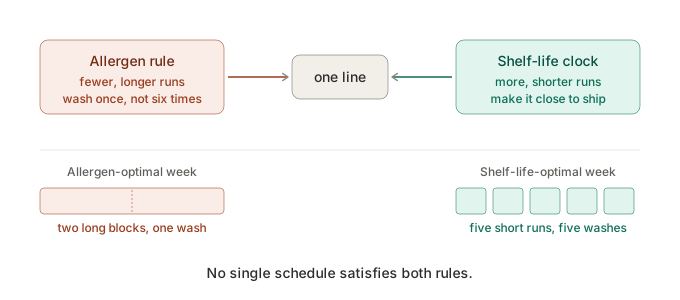
Now run both on the same line. The allergen-optimal order builds your long-dated items early and lets the short-dated ones fall wherever the wash sequence puts them, which is rarely when they ship. The shelf-life-optimal order chops those long campaigns into pieces, and every cut is another washout. There is no sequence that satisfies both. Every schedule you can actually run spends against one rule to serve the other.
Allergen sequencing wants fewer, longer runs. Shelf life wants more, shorter ones. Every real schedule pays one rule to satisfy the other.
The Cost Nobody Traces Back
What hides the conflict is that the two costs are paid by two different people, at two different times.
The washout cost is operational. It is downtime and sanitation labor, it happens on the floor, this shift, and the plant manager sees it land. The shelf-life cost is commercial. It is short-dated product, a rejected load, a markdown to clear inventory before it dies, and it shows up weeks later on a different report. The planner who chose the sequence never sees that second number pinned back to the decision that caused it.
So the plant defends the cost it can see. It runs the long allergen campaigns, because the washout savings are visible this week, and it absorbs the shelf-life penalty quietly at the far end, where a rejected load gets logged as a demand miss or a difficult retailer rather than as a scheduling call made a month earlier. The decision and its cost are never in the same room.
And this is not a small search. A plant running a few dozen SKUs across allergen families, each with its own code date and its own ship window, has more workable weekly orderings than a planner can get through by hand. They find one that clears the wash rule and ships on time. They never find out what the ordering that balanced both would have saved.
The washout shows up on the floor this week. The short-dated load shows up weeks later on someone else's report. Nobody sees them as the same decision.
What Solving It Looks Like
The point is not to pick the right rule. It is to stop making the choice blind.
A model does not have to take a side. It carries the washout cost of every transition, the real code-date requirement of every SKU, and the ship window each one has to hit, and it searches the possible schedules for the one that costs the least across all of it at once. When a longer campaign saves a washout but pushes three products past their dating, the model has both numbers in front of it and weighs them. When a short run protects the date but buys an extra cleanout, it prices that too. The trade gets made on the math instead of on whichever cost the planner could see from where they stood.
That only works inside the whole plan, because both rules reach outward. The wash schedule depends on the raw material and the labor you have that shift. The shelf-life requirement depends on when the order actually ships, which depends on the distribution plan downstream. WonForge solves the allergen sequence and the shelf-life timing together, inside purchasing, production, and shipment, so what comes out is a schedule the floor can run and the retailer will take.
A model prices the washout and the shelf-life penalty against each other and takes the cheapest schedule across both, instead of the one that serves whichever rule the planner could see.
Frequently Asked Questions
What is allergen sequencing in food manufacturing?
Allergen sequencing is running products in an order that minimizes allergen cross-contact washouts. You group like with like, run cleaner or allergen-light work first, and save allergen-heavy products for last, so you wash at family boundaries instead of after every batch. That batching is the right recall-protection rule, and followed to its end it pushes the plant toward fewer, longer production campaigns.
How does shelf life conflict with allergen sequencing?
Allergen sequencing wants fewer, longer runs so you wash once at the boundary instead of many times through the day. Shelf life wants more, shorter runs made close to when product ships, so code dates stay long enough for the retailer. Both rules are correct, and they want opposite schedules. Every schedule you can actually run on one line spends against one rule to serve the other.
Why can't a planner solve this by hand?
A plant with a few dozen SKUs across allergen families, each with its own code date and ship window, has more workable weekly orderings than a planner can search by hand. They find one that clears the wash rule and ships on time, and stop there. The two costs also land in different places: washout downtime shows up on the floor this week, while a short-dated or rejected load shows up weeks later on someone else's report, so both numbers are never in front of the same decision.
Conclusion
The allergen rule is not wrong. The shelf-life clock is not wrong. They are both right, they want opposite schedules, and a person resolving that by hand every week will protect whichever cost is easier to see. The washout is easy to see. It happens on the floor, this shift, in front of the person making the call. The short-dated load is not. It happens later, somewhere else, on a report that never names the sequence behind it. You are not scheduling badly. You are scheduling with half the numbers. Want to see what the other half is costing? Click Check Your Fit and we will take it from there.
Related insights
- The CIP Matrix: Why Spreadsheets Cause the "Friday Washout"Like-with-like sequencing looks efficient on Monday but pushes incompatible CIP transitions into Friday. How end-to-end optimization fixes it.
- The Shelf-Life Squeeze: How Disconnected Schedules Cause Retailer RejectionsLoads rejected for minimum life on receipt often lost that shelf life days earlier in your holding tanks. How to plan product age into the schedule.
- Why Process Plants Sign Off an S&OP Plan the Floor Can't RunEvery month the S&OP plan is signed off, then the floor runs something else. Why the plan and the schedule drift apart, and why one model closes the gap.
Tell us about your hardest planning problem
We'll tell you in 20 minutes whether we can solve it.
Email: contact@wonforge.com
Based in Wilmington, DE, serving businesses across the U.S.