
Insights & Use Cases
Explore our use cases and insights to learn how optimization can transform your business
Why Supplement Plants Overbuy Active on Every Single Lot
Introduction
Somebody picked your overage percentage. Probably years ago. Probably as a round number that felt safe at the time.
It has been applied to every lot of every SKU since. Whether the assay came in hot or came in weak. Whether the batch ships next week or sits in finished goods until spring. The plant is not buying the overage it needs on the lot in front of it. It is buying the overage that covers the worst lot anyone could imagine, and paying for that on every lot it runs.
Ask why, and the answers come fast, and they are all correct. Assay varies. You lose some in the blend. It degrades on the shelf. Under claim is a recall, and nobody is losing their job because we got cheap on the botanical extract.
Fine. But none of that explains why the number is that number. Quality tells you where the floor is. What you spend to stay above it is a planning decision, and it has never been treated like one.
Two Costs, One Root
The first is the active you buy. The assay moves lot to lot. Processing loss moves by line and by form, because a tablet press does not treat an active the way a gummy depositor does. And decay depends on how long the SKU actually sits, so a product that turns in three weeks does not need what one that holds until spring needs. Every one of those is a number the plant already has. All of them get flattened into a single percentage, set for the worst case and charged to every lot. When the assay comes in strong, you overbuy and nobody notices, because the batch passed. Every unnecessary point of that margin is active you purchase, blend, test, and ship, and it does nothing for the label claim.
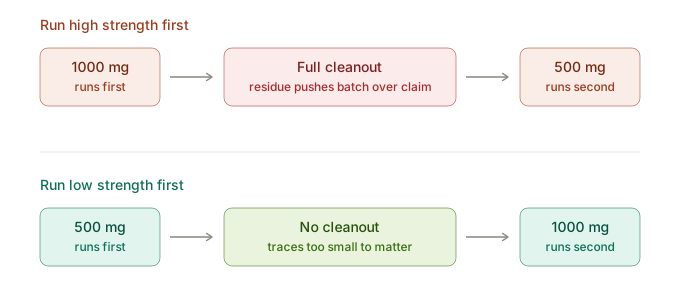
The margin is not the only thing the plan sets. It also sets the sequence, and the sequence has a cost of its own. Take two SKUs, same active, different strengths. Run the 1000mg version, then change over to the 500mg version on the same line, and residue from the first run pushes the second batch over its own label claim. That forces a full cleanout before you can run it at all. Reverse the order and the problem never comes up. Same two products, same line, and the order alone decided the cost. That is before you add allergen washouts, or cherry after mint on the gummy line, or the botanical staining that shows on a light powder and hides on a dark one. There are more ways to order a week than anyone can check, so the planner picks one that works and never finds out what the cheaper one would have saved.
One overage covers every lot, and the sequence sets a second cost nobody counts. Both were decided by the plan.
Why Nobody Has Fixed This for You
Worth asking why a plant running this kind of math is still doing it in a spreadsheet. The planning software industry looked at supplements twice and got it wrong both times.
The enterprise vendors filed you with pharma and priced you for validated processes and qualified equipment, at a number a mid-market manufacturer cannot get approved. Which is absurd, because 21 CFR 111 does not require the process validation that locks a drug plant's schedule in place. You were priced for a wall that is not in front of you.
Everyone else sold you a food plant template. Fixed recipe, flat changeover, one setup time per line. Fine for a snack producer. Nowhere at all to put an overage that should move with the product, or a changeover cost that depends on what ran an hour ago.
You took neither, and the spreadsheet stayed. Quoted like a drug manufacturer. Scheduled like a cereal plant.
Priced like pharma, scheduled like food. Nothing on the shelf was built for the plant you actually run.
What Solving It Looks Like
The overage stops being a constant. Right now one percentage covers every SKU. But the protection a product needs depends in part on how long it is expected to sit, and the production plan is one of the biggest drivers of that time. A fast-turning SKU and one that holds in finished goods until spring do not need the same margin, and the plan has a large say in which one you are making. The model carries the decay profile for each product and the real shelf time the schedule gives it, and sizes the margin that clears label claim for that combination, along with the loss rate of the line it runs on. The plant stops paying spring protection on a product that ships in three weeks.
Then the sequence gets solved instead of inherited. The changeover matrix goes in as real data, potency direction included, along with allergen families, color and flavor carryover, and cleaning time per transition. The model searches the possible schedules and returns the one that clears demand at the lowest total cost, rather than the one that looks tidy on a Gantt chart.
And the two get solved together, because one determines the other. Sequence determines shelf time. Shelf time determines the overage the product requires. Solve them in separate tabs and you guarantee cost that did not have to be there, because each answer was chosen without knowing what the other one was going to do.
WonForge plans all of it inside the rest of the chain. Botanical lead times run long and seasonal. Blending and encapsulation capacity is finite. Ship dates are real. The plan that comes out is one the plant can run on Monday, not one that gets reconciled by hand on Friday.
Solved apart, the overage and the sequence each guarantee cost the other could have prevented. Solved together, the margin you buy is the one you actually needed.
Frequently Asked Questions
What is potency overage in supplement manufacturing?
Potency overage is the extra active ingredient a plant buys above the label claim so the finished product still clears claim after assay variation, process loss, and shelf-life decay. The active is the ingredient that carries the claimed amount, like a botanical extract or vitamin. The assay is the measured potency of that specific raw lot, and it moves lot to lot, supplier to supplier, and harvest to harvest. When a plant applies one fixed overage percentage to every SKU, it is buying spring-level protection even for products that ship in three weeks. The planning contribution is sizing that margin to the real shelf time the schedule gives a product and the loss rate of the line it runs on, rather than covering every SKU with the same worst-case percentage.
Are supplement manufacturers regulated like pharmaceutical manufacturers?
No. Dietary supplement manufacturers operate under 21 CFR 111, which requires real quality systems, laboratory controls, and batch production records. What it does not require is process validation and equipment qualification, the things that lock a pharmaceutical schedule in place under 21 CFR 211. Part 111 is generally less stringent and more flexible than Part 211, and validation is not a Part 111 requirement. The commercial consequence is that planning vendors often quote supplement manufacturers as if they were validated drug facilities, at a price a mid-market manufacturer cannot get approved, for a regulatory wall that is not the one in front of them.
Why does changeover sequence affect supplement production cost?
Because changeover cost in a supplement plant is sequence-dependent. Run a lower-potency product behind a higher-potency one and residual active can carry forward, pushing the next batch up, which is the direction that risks breaking a label claim, so you clean for it properly or you do not run it at all. Reverse the order and those same two products can be a cheap transition. Allergen washouts, flavor carryover, and botanical staining add the same kind of directional cost. The sequence you chose already decided what the next washout would cost.
Conclusion
The overage is not a quality number. Quality sets the floor. What you spend clearing it is a planning decision that has been sitting unexamined in a cell for years, and the sequence driving a second cost alongside it was never in the conversation at all. You are not in a spreadsheet because the spreadsheet is good. You are in a spreadsheet because the market quoted you like pharma and scheduled you like food, and neither one was ever you. Want to see what your overage and your sequence are actually costing? Click Check Your Fit and we will take it from there.
Related insights
- Custom Optimization is for Process ManufacturingProcess plants need optimization that puts changeovers, by-products, tanks, and shelf life in the math. Why custom fits where templates fall short.
- Sequence-Dependent Changeover Optimization in Specialty Chemical Manufacturing: Why Standard Planning Tools Fail and What Actually WorksStandard ERPs destroy chemical plant capacity by treating complex changeovers as static averages. Discover how sequence optimization unlocks hidden margin.
- The CIP Matrix: Why Spreadsheets Cause the "Friday Washout"Like-with-like sequencing looks efficient on Monday but pushes incompatible CIP transitions into Friday. How end-to-end optimization fixes it.
Tell us about your hardest planning problem
We'll tell you in 20 minutes whether we can solve it.
Email: contact@wonforge.com
Based in Wilmington, DE, serving businesses across the U.S.