Insights & Use Cases
Explore our use cases and insights to learn how optimization can transform your business
Insights
Latest insights and thought leadership on optimization, analytics, and manufacturing excellence.
Your CIP Matrix is the most expensive constraint you are ignoring.
Introduction
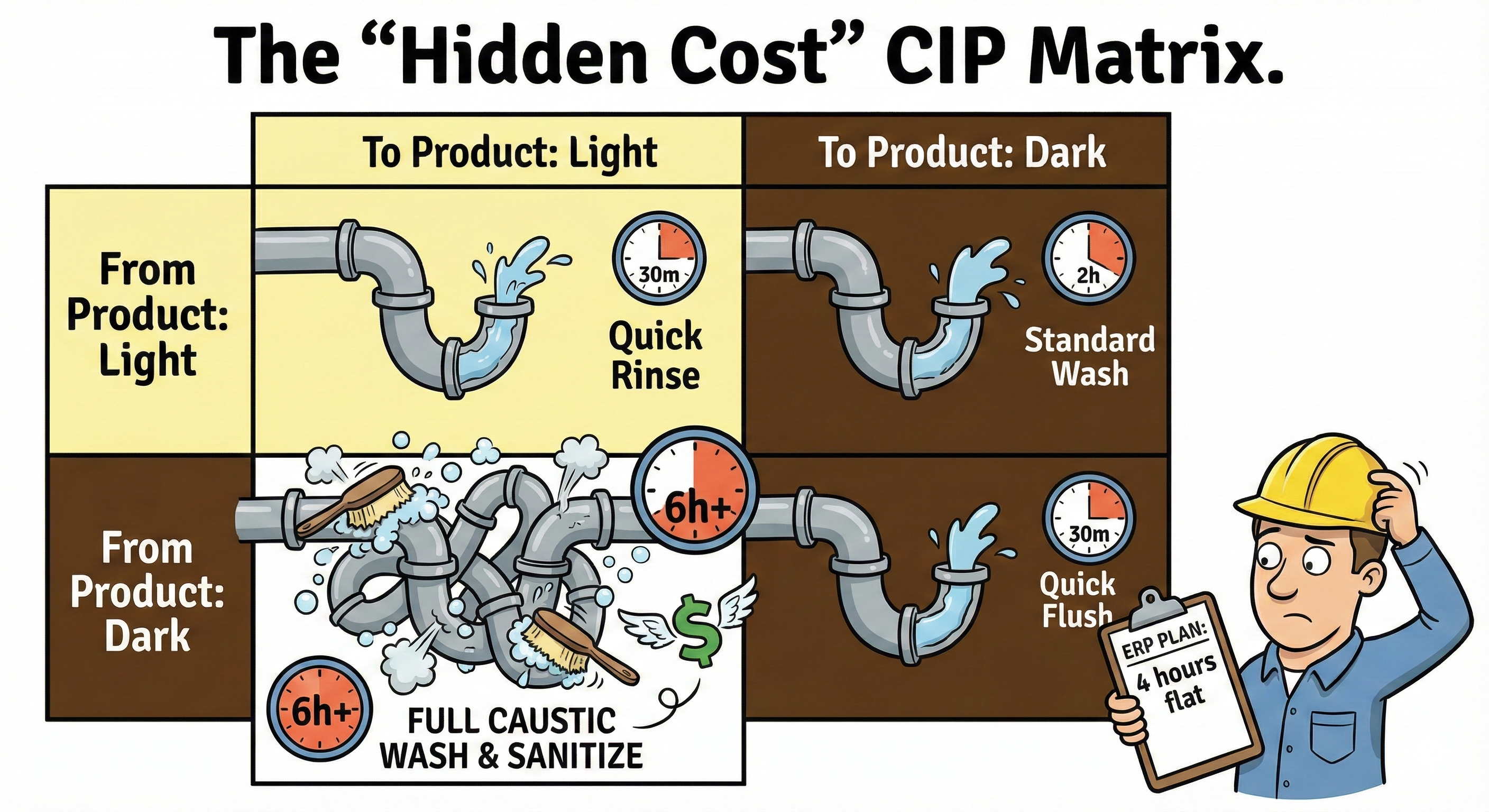
There is a dangerous lie buried in your ERP's master data. It's usually labeled "Setup Time" or "Changeover Duration," and it is almost always a single, static number—like "4 hours." Your Plant Manager knows this number is fiction. In the process industry, the time it takes to switch products isn't fixed; it is directional. Switching from a light-colored product to a dark one might take 30 minutes (a simple flush). Switching from dark back to light might take 6 hours (a full caustic wash, rinse, and swab test). If your production plan treats these two events as equal because your software assumes a "standard" changeover time, you aren't just losing capacity. You are literally flushing margin down the drain in water, chemicals, and energy costs.
1. The Physics of the Matrix
In discrete manufacturing (like assembling cars), a "setup" is usually about changing tools. In process manufacturing (chemicals, dairy, food), a "setup" is about physics and chemistry. The Clean-In-Place (CIP) process is governed by a matrix of constraints that most planning tools simply ignore:
- Color Sequencing: Light → Dark is cheap. Dark → Light is expensive.
- Allergen Breaks: Running a non-allergen after an allergen requires a "Full Wash" that halts the line for hours.
- Viscosity & Chemistry: Some products react with each other. You can't just follow Product A with Product B; you might need an intermediate "buffer" product or a solvent cycle.
Your operators are likely manually overriding the schedule every week to fix these sequencing errors. They know that following the "official" plan would result in unnecessary 6-hour washes, so they reshuffle the deck based on tribal knowledge.
2. The Combinatorial Trap
Why can't a human planner just "group like with like" to minimize washing? It works fine if you have one tank and three products. But that isn't your reality. You likely have dozens of tanks, shared headers, manifold constraints, and hundreds of recipes. This turns the scheduling problem into a variation of the "Traveling Salesman Problem."
- If you have 5 tanks and 20 orders, there are millions of possible sequences.
- A human brain—or a spreadsheet—cannot calculate the total "CIP Penalty" for every possible combination to find the global minimum.
- Humans default to "Greedy Optimization": they pick the best next move. But taking a short changeover now might force a catastrophic 12-hour washout later in the week.
You don't have a scheduling problem. You have a mathematical optimization problem that exceeds human cognitive capacity.
3. The Hidden Cost of Sustainability
Optimizing your CIP matrix isn't just about unlocking hidden capacity (though it often yields 5-10% more throughput). It is a direct financial lever for your variable costs. Every unnecessary "Full Wash" consumes:
- Water: Thousands of gallons of high-quality industrial water.
- Energy: The BTU cost of heating that water to 180°F (82°C).
- Chemicals: Expensive caustic sodas and sanitizers that erode your margin.
- Effluent: The cost to treat the wastewater you just generated.
When you optimize the sequence to minimize the severity of washes, you are attacking your utility bill and your carbon footprint simultaneously.
Conclusion
You don't need a faster production line. You need a smarter sequence. WonForge doesn't rely on "standard averages." Our engine ingests your specific CIP Matrix as a hard constraint. We model the sequence-dependent setup times and costs for every product pair (A → B vs. B → A). The result is a plan that mathematically guarantees the minimum possible cleaning downtime for your specific mix of demand. Stop treating CIP like a fixed number. It's a matrix, and it's costing you millions.
See What WonForge Finds in Your Data
Book a feasibility call to evaluate your planning challenges and see how custom optimization can protect your P&L.
Email: contact@wonforge.com
Based in Wilmington, DE, serving businesses across the U.S.