Insights & Use Cases
Explore our use cases and insights to learn how optimization can transform your business
Insights
Latest insights and thought leadership on optimization, analytics, and manufacturing excellence.
The Profitability Illusion in Process Manufacturing
Introduction
There is a classic tension in manufacturing: Sales celebrates a massive new contract, while Operations groans. Why? Because while the volume is high, the complexity is higher. In process industries, not all volume is created equal. A standard product run is profitable. But a "slightly customized" formulation, a non-standard package size, or a strict delivery window requires tank washouts, line changeovers, and overtime that spreadsheets rarely capture. The result? You might be servicing your largest customer at a loss.
1. The "Average Cost" Trap
Most manufacturers calculate margin using "Standard Costing." They take total plant overhead and divide it by total volume. This smears the cost of complexity across everyone.
- The Reality: The customer buying the standard white paint is subsidizing the customer buying the small-batch neon green paint.
- The Problem: You think both customers are profitable. In reality, one is a cash cow, and the other is a cash drain.
To see the truth, you need to stop looking at averages and start looking at Scenarios.
2. The Power of Parallel Scenarios
It is impossible to find the true cost of a complex customer simply by looking at a spreadsheet. The only way to measure their actual impact is to run the numbers two ways: with them and without them. This is where WonForge's Scenario Planning steps in. You can clone your production model and solve two parallel futures instantly:
- Scenario A (Baseline): The optimal plan including the complex customer's orders.
- Scenario B (Alternative): The optimal plan excluding or deferring those orders.
By comparing the bottom line of these two scenarios, the "hidden costs" immediately surface. You might find that removing $50k of revenue from a difficult customer actually increases your total profit by eliminating costly changeovers and unlocking capacity for higher-margin goods.
3. From "Can We Make It?" to "Should We Make It?"
Most planning systems ask, "Do we have the capacity to fill this order?" Scenario-based optimization asks, "Does filling this order increase our total EBITDA?" You can test strategic questions before you sign the contract:
- What-If: We accept this rush order? (Does it force a break in a high-efficiency campaign?)
- What-If: We enforce a strict "Full Tank" Minimum Order Quantity (MOQ)? (How much waste does that eliminate?)
- What-If: We shift this customer's volume to next week? (Does that smooth out the labor requirement?)
Scenario-based optimization shifts planning from feasibility to profitability.
4. Empowering the Commercial Conversation
This doesn't mean you have to fire the customer. Once you run these scenarios, you enter negotiations with hard evidence.
- Strategic Surcharges: "We ran a simulation, and your custom formulation triggers a cleaning cycle that costs us $4,000 per run. We need to adjust the price to cover that impact."
- Win-Win Adjustments: "Our model shows that if you can accept delivery on Thursdays instead of Mondays, we can reduce your price because it fits our optimal sequence."
Armed with scenario analysis, you can turn unprofitable relationships into win-win partnerships through data-driven negotiations.
Conclusion
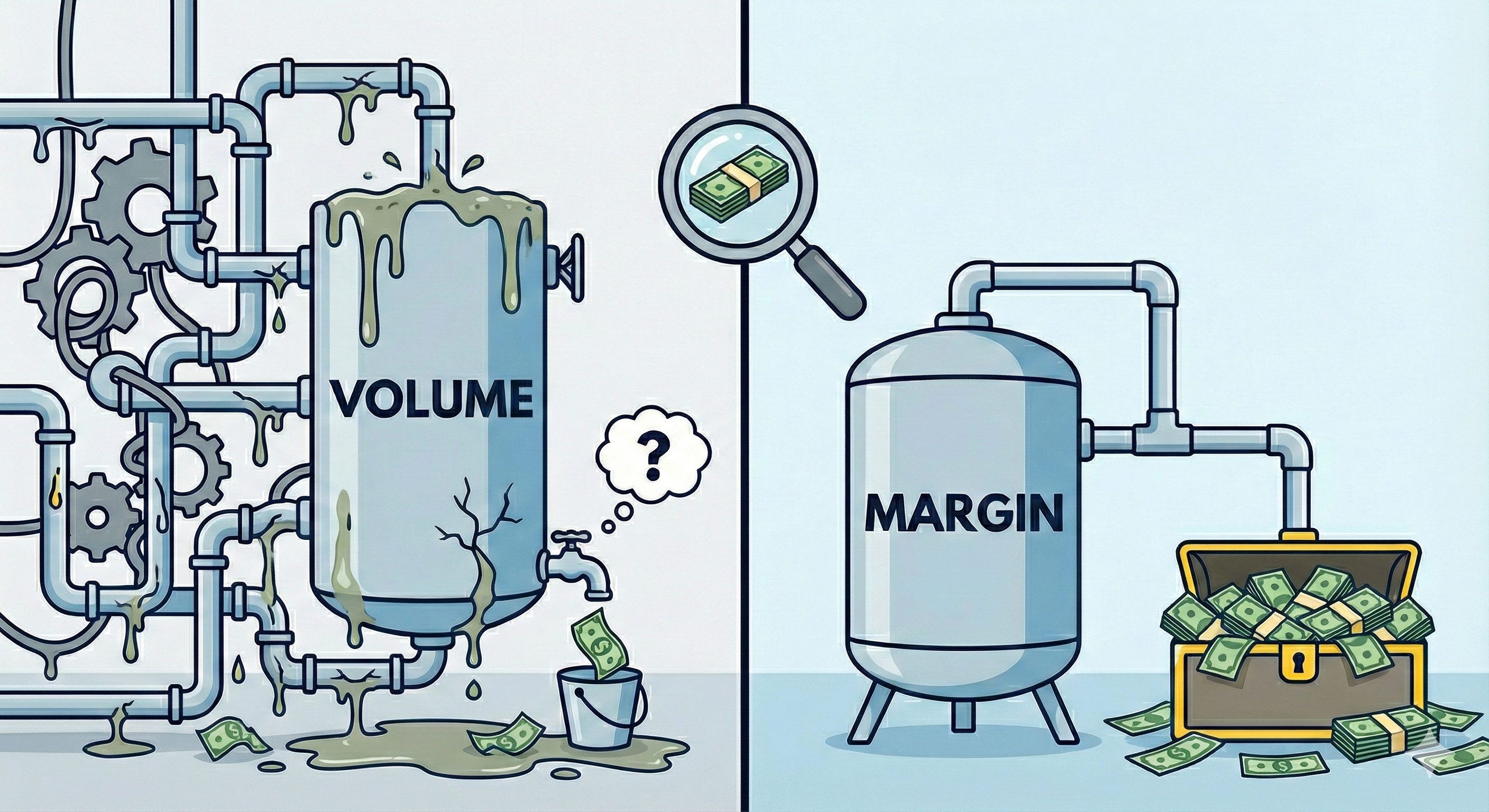
Volume is vanity; margin is sanity. If you are planning based on averages, you are likely losing money on your most complex accounts without knowing it. WonForge's Scenario Planning gives you the ability to isolate the financial impact of every operational decision, ensuring that you aren't just running your plant harder, but running it smarter.
See What WonForge Finds in Your Data
Book a feasibility call to evaluate your planning challenges and see how custom optimization can protect your P&L.
Email: contact@wonforge.com
Based in Wilmington, DE, serving businesses across the U.S.