Insights & Use Cases
Explore our use cases and insights to learn how optimization can transform your business
Insights
Latest insights and thought leadership on optimization, analytics, and manufacturing excellence.
The By-Product Trap: Why Generic ERPs Fail in Chemical Manufacturing
Introduction
In chemical and process manufacturing, physics dictates a messy reality. When you fire up a reactor to synthesize your primary product, you rarely get just one output. You inevitably yield secondary streams—like co-products and by-products.
Unlike simple scrap, a by-product is an inferior but usable material that has its own inventory lifecycle. It has to be stored, routed, consumed, or sold.
Most generic supply chain planning software cannot handle this reality—actively creating operational churn and hidden costs on your plant floor.
1. The "One-In, One-Out" ERP Illusion
Most legacy ERPs and standard supply chain planning tools are built on linear Bills of Materials (BOMs). Because these systems assume production is a one-way street, they only plan for the primary finished good. They treat secondary outputs—like usable by-products—as invisible afterthoughts. As long as you have the raw materials and the open reactor time, the software assumes the plan is ready. But in the chemical industry, a valid production plan isn't just about what goes into the reactor; it is about where every usable output goes when it comes out. Standard planning tools optimize for the primary product while ignoring the physics of secondary outputs. In process manufacturing, ignoring your by-product inventory guarantees operational chaos.
In process manufacturing, ignoring your by-product inventory guarantees operational chaos.
2. The Silent Bottleneck: When the Secondary Tank Dictates Production
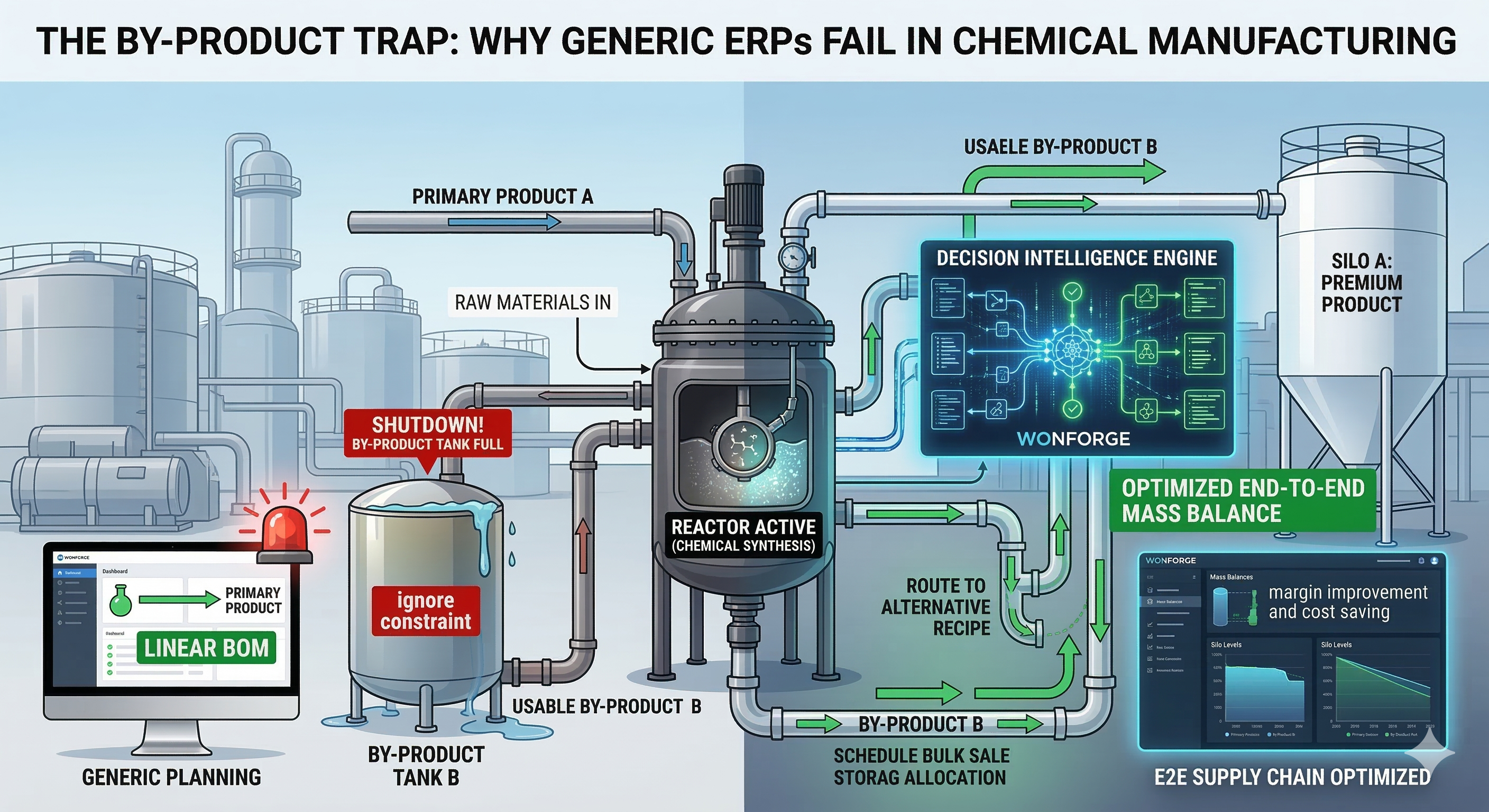
Because generic tools struggle with divergent outputs, planners are often forced to manage by-product inventory manually on separate spreadsheets. This creates a dangerous operational disconnect. Your ERP might generate what looks like a perfectly feasible two-week campaign for your premium product. The reactor starts running flawlessly. But three days in, the secondary tank catching the lower-grade by-product hits 100% capacity. Because this inferior-but-usable product hasn't been mathematically allocated to downstream demand or alternative recipes, it has nowhere to go. Operations has to scramble. They might have to break a highly profitable campaign early or drum off the by-product into expensive emergency totes. You just incurred a massive cost—not because demand for your primary product dropped, but because your software failed to plan for the secondary one. When your software fails to model by-products, your multimillion-dollar reactor is held hostage by the capacity of your secondary tanks.
When your software fails to model by-products, your multimillion-dollar reactor is held hostage by the capacity of your secondary tanks.
3. Optimizing the End-to-End Mass Balance
To stop this margin leak, you have to abandon linear planning frameworks. You need true end-to-end supply chain planning built specifically for the chemical and process manufacturing industries. A modern Decision Intelligence engine synchronizes the entire chemical reality of the batch. In an optimized end-to-end supply chain model, by-product generation and storage are treated as hard mathematical constraints—and economic opportunities. When WonForge evaluates a production run, the engine simultaneously calculates the fill rates of the primary holding tanks and the secondary by-product tanks. If the math shows the by-product tank will max out, the engine automatically adjusts the plan in advance. It might route that by-product into a lower-tier formulation, sequence a different product, or trigger a bulk sale, ensuring the primary reactor maintains its steady state.
- Route the by-product into a lower-tier formulation.
- Sequence a different product to free tank capacity.
- Trigger a bulk sale to clear the secondary stream before it blocks the reactor.
A Decision Intelligence engine treats by-product tanks as hard constraints and adjusts the plan in advance—so your reactor is never held hostage by a full secondary tank.
Conclusion
Every time an overflowing secondary tank forces a reactor shutdown or an emergency washout, it directly erodes your EBITDA. To see how end-to-end supply chain optimization can stop schedule churn, eliminate premium disposal fees, and turn your physical constraints into measurable cost savings, request a Feasibility Check.
See What WonForge Finds in Your Data
Book a feasibility call to evaluate your planning challenges and see how custom optimization can protect your P&L.
Email: contact@wonforge.com
Based in Wilmington, DE, serving businesses across the U.S.