Insights & Use Cases
Explore our use cases and insights to learn how optimization can transform your business
Insights
Latest insights and thought leadership on optimization, analytics, and manufacturing excellence.
Tank Farm Optimization: How to Unlock "Ghost Capacity" Without CapEx
Introduction
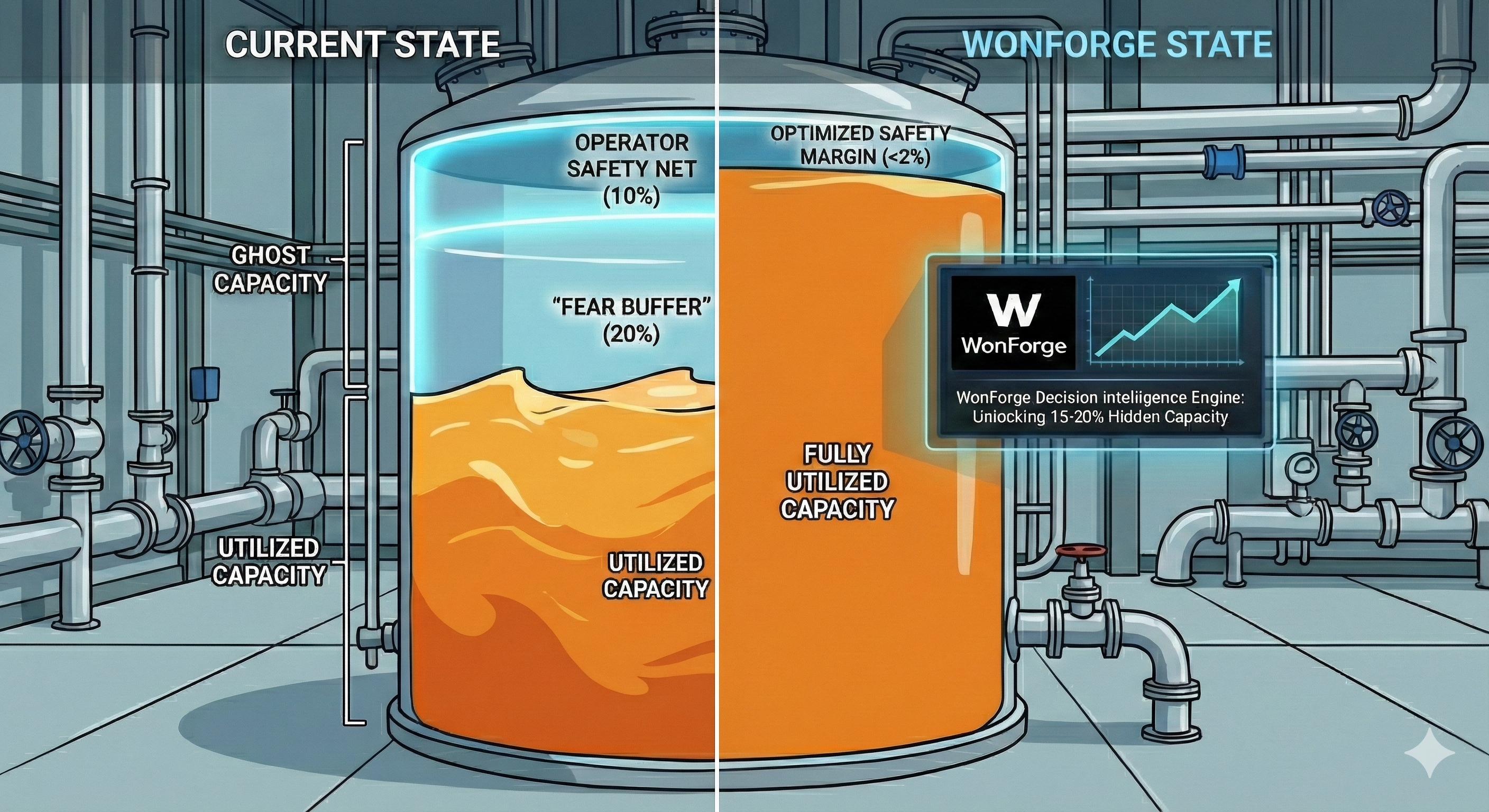
In Specialty Chemicals and Performance Materials, the tank farm is often your most strategic—and most underutilized—asset. It's where the physics of viscosity, melting, and reactions meet the pressure of the delivery schedule. But for many organizations, a significant portion of this critical buffer is "Ghost Capacity"—space that appears on the site map but is effectively invisible to the operation.
Safety Buffers on Top of Safety Buffers
Most plants operate with massive invisible layers of protection because static planning tools cannot calculate the "ripple effect" of a production change in real-time.
- The Spreadsheet Survival Strategy: Research shows that over 80% of supply chain planning processes still rely on Excel. Because these sheets are disconnected from the true physics of the plant floor, planners are forced to maintain a 20% "fear buffer" to handle the unexpected.
- The Operational Safety Net: To protect against high-level alarms or spill risks during complex changeovers, floor operators often keep another 10% empty "just in case."
- The "Hidden Tax" on OEE: This cumulative 30% buffer is a direct tax on your margins. It forces shorter campaigns, more frequent washouts, and unnecessary waste because the system "thinks" the plant is full when it's actually just poorly synchronized.
Ghost Capacity is the gap between what your site map says you have and what your operation dares to use—and it's costing you every day.
The Barrier is the Tool, Not the Talent
Planners in this niche are master navigators of "Tank Tetris," but they are often handcuffed by ERP outputs that use static planning logic. Most ERPs assume infinite capacity and ignore the reality of sequence-dependent changeovers—like the fact that switching from a high-viscosity resin to a light coating requires a 6-hour caustic wash. When the software doesn't understand the physics, the only way a planner can protect the plant is with a safety margin.
The constraint isn't your people; it's that the tools don't model the physics, so the only defense is buffer.
The WonForge Value: Empowering the "Strategic" Planner
WonForge provides the Decision Intelligence Engine that turns these operational "fear buffers" into a profit center.
- Synchronized Confidence: Our engine simulates thousands of scenarios across your entire network, proving exactly how much head-space is needed. When the math guarantees a tank can be safely filled to 98%, that "Ghost Capacity" suddenly becomes real, usable volume.
- Unlocking Hidden Capacity: Instead of spending $100,000+ on a new 50,000-gallon tank installation, you can reclaim 15-20% of the capacity you already own.
- Strategic Leverage: Your team can finally move from "making it fit" to "making it profitable"—using that reclaimed capacity to buy raw materials at lower prices or pre-build inventory for peak season.
Turn fear buffers into a profit center with high-fidelity tools that unlock the full potential of your existing assets.
Conclusion
Stop managing your tanks with a "fear buffer." Give your planners the high-fidelity tools they need to unlock the full potential of your existing assets.
See What WonForge Finds in Your Data
Book a feasibility call to evaluate your planning challenges and see how custom optimization can protect your P&L.
Email: contact@wonforge.com
Based in Wilmington, DE, serving businesses across the U.S.