An advanced materials network uses an end-to-end optimization framework to synchronize tanks, reactors, and distribution nodes within a single planning model.
Advanced materials manufacturers operate multi-echelon supply chains with upstream tanks, reactors, and shared intermediates. Without a unified model, manual planning struggles to balance capacity, inventory, and shipment priorities across tightly coupled networks.
The optimization framework integrates material, production, and shipment planning across the entire supply chain, enabling planners to evaluate trade-offs and publish executable plans in a single run.
An integrated optimization model replaces fragmented spreadsheets with a single decision engine, giving advanced materials manufacturers clearer trade-offs across production, inventory, and transportation.
Dynamic workforce optimization aligns staffing plans with volatile e-commerce demand, replacing reactive spreadsheets with automated recommendations.
Large e-commerce networks often struggle to align workforce planning with rapid growth. Spreadsheet-based planning fails to keep up with daily fluctuations, leading to overstaffing and service shortfalls.
Wonforge deploys a dynamic optimization model to replace spreadsheet management. The solution integrates forecasted contact volumes, labor availability, and performance variability into a single framework that automatically recommends updated staffing plans.
This optimization framework replaces reactive scheduling with proactive planning. By modeling variable performance metrics, companies can achieve higher efficiency, improved service reliability, and greater operational agility.
Tree fruit cooperatives use integrated optimization to align harvest timing, processing capacity, workforce scaling, and transportation.
Tree fruit cooperatives manage short harvest windows, fluctuating seasonal labor, and immediate processing requirements. Without advanced planning, pallet configurations, truck loading, and workforce deployment quickly become bottlenecks.
The integrated model coordinates harvest scheduling, pallet optimization, truck loading, and workforce planning. It captures fruit-handling constraints, transportation limits, and seasonal demand patterns to keep the entire harvest-to-market pipeline synchronized.
Coordinated optimization across harvest, labor, processing, and logistics turns seasonal operations into a predictable, data-driven program that protects quality while controlling cost.
Dairy producers rely on optimization to keep short-shelf-life products synchronized across production, cold storage, and transportation.
Dairy networks juggle short shelf lives, temperature-controlled storage, and variable demand across multiple product lines. Manual planning often drives spoilage, inefficient distribution, and missed revenue.
The perishable optimization model enforces shelf-life, temperature, and demand constraints while connecting production planning with distribution decisions.
Perishable supply chains benefit from optimization models that blend production, cold-chain logistics, and demand sensing—turning freshness management into a measurable, repeatable process.
Every legacy vendor brags about AI making their teams 10x more productive. So why are you still getting multi-million-dollar implementation quotes? The question every CFO and IT Director should ask—and how WonForge delivers value without the enterprise price tag.
Every legacy tech vendor is bragging right now about how AI has made their engineering teams 10x more productive. They claim they can build, code, and deploy faster than ever before.
So here is the question every CFO and IT Director should be asking: If the vendor's internal costs have plummeted, why are you still getting quotes for multi-year, multi-million-dollar software implementations?
It means one of two things must be true: The enterprise giants are keeping 100% of that productivity dividend for their own bloated margins, or their "AI efficiency" hype is wildly exaggerated.
Either way, mid-market process manufacturers shouldn't have to fund a vendor's profit margin just to get their plant off spreadsheets. Innovation shouldn't just change the code—it should change the business model.
We deliver end-to-end supply chain planning built specifically for the physical realities of the Process Industry. We optimize your most difficult sequencing logic (like complex grade-to-grade transitions) to minimize changeover waste, while strictly enforcing your inventory and shipment constraints. We stripped away the historic barriers to entry so you only pay for the value:
Key Point: You shouldn't have to choose between a fragile spreadsheet and an overpriced IT nightmare.
See how we deliver ROI without the IT headache.
In Specialty Chemicals and Performance Materials, the tank farm is often your most strategic—and most underutilized—asset. Discover how "Ghost Capacity"—space that appears on the site map but is invisible to the operation—is costing you margins, and how to reclaim it.
In Specialty Chemicals and Performance Materials, the tank farm is often your most strategic—and most underutilized—asset. It's where the physics of viscosity, melting, and reactions meet the pressure of the delivery schedule. But for many organizations, a significant portion of this critical buffer is "Ghost Capacity"—space that appears on the site map but is effectively invisible to the operation.
Most plants operate with massive invisible layers of protection because static planning tools cannot calculate the "ripple effect" of a production change in real-time.
Key Point: Ghost Capacity is the gap between what your site map says you have and what your operation dares to use—and it's costing you every day.
Planners in this niche are master navigators of "Tank Tetris," but they are often handcuffed by ERP outputs that use static planning logic. Most ERPs assume infinite capacity and ignore the reality of sequence-dependent changeovers—like the fact that switching from a high-viscosity resin to a light coating requires a 6-hour caustic wash. When the software doesn't understand the physics, the only way a planner can protect the plant is with a safety margin.
Key Point: The constraint isn't your people; it's that the tools don't model the physics, so the only defense is buffer.
WonForge provides the Decision Intelligence Engine that turns these operational "fear buffers" into a profit center.
Key Point: Turn fear buffers into a profit center with high-fidelity tools that unlock the full potential of your existing assets.
Stop managing your tanks with a "fear buffer." Give your planners the high-fidelity tools they need to unlock the full potential of your existing assets.
Every scheduler monitors the rework tank. The difference between a good schedule and an optimal one isn't about using rework—it's about when you use it. Discover how optimization turns disposal into monetization.
Every scheduler monitors the Rework (or 'Slop') tank. You know it represents potential margin, and you actively look for opportunities to blend it back in. But when you're managing 50 tanks and complex changeovers in a spreadsheet, you can't calculate the financial impact of every gallon across the horizon. The sheet forces you into a "First Feasible" rule: If the tank is getting full, put it in the next batch that allows it. That keeps the plant running, but it leaks margin. The difference between a "Good" schedule and an "Optimal" one isn't about using the rework—it's about when you use it. Here is how optimization shifts the logic from disposal to monetization:
A spreadsheet can't evaluate margin per gallon across your full schedule. If Generic Product A is running tomorrow and allows 10% rework, the sheet (or the rule you encode in it) says use it to clear the tank. Product A uses cheap base stocks—replacing them saves you pennies. The optimized choice: The engine sees Premium Product B scheduled for Friday, which uses expensive synthetic raw materials. It calculates that holding the inventory for 3 days captures 4x the savings per gallon, justifying the storage cost.
Key Point: The engine holds rework for high-margin formulations when the math justifies it—turning storage from a problem into strategic leverage.
Spreadsheets typically rely on a short list—a "Top 5" of formulations that allow rework—because scanning the full formulation library in Excel is impractical. But your technical database might contain 50 low-volume SKUs that are also valid candidates. WonForge scans the entire formulation library instantly. It identifies consumption opportunities in the "long tail" of your portfolio—obscure batches that relieve tank pressure without impacting your primary products.
Key Point: WonForge scans the entire formulation library instantly, identifying long-tail opportunities that spreadsheets can't easily surface.
We don't use static safety rules like "Sell if > 90% full." Optimization treats tank capacity as a dynamic economic constraint. The engine calculates the precise value of your storage capacity dynamically. When tank pressure is low, the engine is "selective," holding out for high-margin formulations. As tank pressure rises, the "cost" of holding inventory increases mathematically, forcing the model to accept lower-margin options to protect the sequence.
Key Point: It's a continuous sliding scale, not a rigid rule—storage is valued dynamically so every gallon goes to its most profitable home.
You are already doing the hard work of capturing and recycling flush. But by relying on spreadsheets and manual rules, you are likely consuming that valuable resource in the wrong products. WonForge adds the computational power to match your waste inventory to its most profitable home, ensuring every gallon of slop works as hard as possible for your bottom line.
Consultants love to cut working capital. But in process manufacturing, slashing tank levels can destroy your OEE. Discover why inventory is essential for physics.
If you hire a generic 'Lean Consultant' from the automotive industry, the first thing they will do is look at your Tank Farm and panic: 'Look at all this cash tied up in WIP! We need to slash tank levels to free up working capital!' This is dangerous advice.
In assembly lines (Discrete), inventory between stations is waste. It hides defects. Consultants apply this logic to process plants, not realizing that in liquids, Inventory equals Time.
Key Point: They see idle cash. The Plant Manager sees the only thing keeping the plant running.
You are managing a conflict between Upstream and Downstream. The Reactor (Upstream) wants to run continuous 24/7. The Packaging Line (Downstream) is stop-and-start.
Key Point: The liquid in the tank is the mechanical shock absorber that decouples these two conflicting physics.
When you arbitrarily cut tank levels to hit a financial KPI, you remove the shock absorber. You might save $50k in working capital, but you lose $500k in OEE and Yield because your reactor keeps tripping.
Key Point: Don't minimize inventory. Optimize the buffer.
The goal isn't Zero Inventory. The goal is the mathematically optimal level that protects your throughput without bloating your balance sheet. WonForge's decision engine calculates the precise buffer levels needed to decouple upstream and downstream operations while minimizing working capital. We model the trade-offs between inventory costs, OEE impact, and service levels to find the buffer that maximizes profitability—not just minimizes cash. Sometimes, the most profitable decision is to fill the tank.
If you ship pails, standard planning works. If you ship railcars, it fails. Discover why 'closed-loop' logistics require a completely different approach to inventory.
There is a massive divide in the process industry: Packaged vs. Bulk. If you ship paint in 5-gallon pails or additives in drums, your logistics act like Amazon—the container is a sunk cost that never returns. But if you ship bulk product in Railcars or ISO Tanks, you are operating in a closed loop. Standard planning software treats every shipment like a one-way trip. For your packaged lines, this works fine. For your bulk fleet, this is a dangerous oversimplification. If you ignore the return trip of your "packaging," you aren't just risking higher freight costs; you are risking a total plant shutdown.
Standard inventory models (like EOQ) calculate optimal production quantities based on holding costs and demand. This works for packaged goods because the container is disposable. It fails for bulk because the container is a capital asset.
Key Point: While both industries deal with lot sizes, only the bulk industry has its production capacity dictated by the return trip of its packaging. If your fleet is stuck at a customer site, your plant stops—even if you have empty tanks and full silos.
The most common failure in chemical planning isn't running out of raw materials; it is running out of empty cars to fill. This is the concept of the "Rolling Warehouse." Your inventory isn't just sitting in a static tank at the plant; it is strung out across 2,000 miles of track.
Key Point: If you don't plan the return trip (RTT), you are planning a shutdown.
Most schedulers treat the fleet size as a fixed wall: "We only have 100 cars, so we have to cut sales." This is the wrong approach. The goal of optimization isn't just to restrict your plan to fit the fleet; it is to identify when the fleet is the bottleneck so you can fix it.
Key Point: You move from "managing shortages" to "justifying equipment investment" with hard math.
Don't just schedule your fleet; synchronize it. WonForge delivers a true end-to-end supply chain model that links production scheduling, shipment planning, and customer demand into a single unified plan. We treat your fleet not as an afterthought, but as an integral part of the value chain—ensuring your logistics capacity matches your production ambition.
Stop optimizing for speed. Start optimizing for the physics of your tank farm. Discover how sequence-dependent changeover times are costing you millions in unnecessary cleaning cycles.
There is a dangerous lie buried in your ERP's master data. It's usually labeled "Setup Time" or "Changeover Duration," and it is almost always a single, static number—like "4 hours." Your Plant Manager knows this number is fiction. In the process industry, the time it takes to switch products isn't fixed; it is directional. Switching from a light-colored product to a dark one might take 30 minutes (a simple flush). Switching from dark back to light might take 6 hours (a full caustic wash, rinse, and swab test). If your production plan treats these two events as equal because your software assumes a "standard" changeover time, you aren't just losing capacity. You are literally flushing margin down the drain in water, chemicals, and energy costs.
In discrete manufacturing (like assembling cars), a "setup" is usually about changing tools. In process manufacturing (chemicals, dairy, food), a "setup" is about physics and chemistry. The Clean-In-Place (CIP) process is governed by a matrix of constraints that most planning tools simply ignore:
Key Point: Your operators are likely manually overriding the schedule every week to fix these sequencing errors. They know that following the "official" plan would result in unnecessary 6-hour washes, so they reshuffle the deck based on tribal knowledge.
Why can't a human planner just "group like with like" to minimize washing? It works fine if you have one tank and three products. But that isn't your reality. You likely have dozens of tanks, shared headers, manifold constraints, and hundreds of recipes. This turns the scheduling problem into a variation of the "Traveling Salesman Problem."
Key Point: You don't have a scheduling problem. You have a mathematical optimization problem that exceeds human cognitive capacity.
Optimizing your CIP matrix isn't just about unlocking hidden capacity (though it often yields 5-10% more throughput). It is a direct financial lever for your variable costs. Every unnecessary "Full Wash" consumes:
Key Point: When you optimize the sequence to minimize the severity of washes, you are attacking your utility bill and your carbon footprint simultaneously.
You don't need a faster production line. You need a smarter sequence. WonForge doesn't rely on "standard averages." Our engine ingests your specific CIP Matrix as a hard constraint. We model the sequence-dependent setup times and costs for every product pair (A → B vs. B → A). The result is a plan that mathematically guarantees the minimum possible cleaning downtime for your specific mix of demand. Stop treating CIP like a fixed number. It's a matrix, and it's costing you millions.
Revenue does not equal profit. Discover how scenario-based optimization reveals which high-volume customers are actually destroying your margins by exposing the true Cost-to-Serve.
There is a classic tension in manufacturing: Sales celebrates a massive new contract, while Operations groans. Why? Because while the volume is high, the complexity is higher. In process industries, not all volume is created equal. A standard product run is profitable. But a "slightly customized" formulation, a non-standard package size, or a strict delivery window requires tank washouts, line changeovers, and overtime that spreadsheets rarely capture. The result? You might be servicing your largest customer at a loss.
Most manufacturers calculate margin using "Standard Costing." They take total plant overhead and divide it by total volume. This smears the cost of complexity across everyone.
Key Point: To see the truth, you need to stop looking at averages and start looking at Scenarios.
It is impossible to find the true cost of a complex customer simply by looking at a spreadsheet. The only way to measure their actual impact is to run the numbers two ways: with them and without them. This is where WonForge's Scenario Planning steps in. You can clone your production model and solve two parallel futures instantly:
Key Point: By comparing the bottom line of these two scenarios, the "hidden costs" immediately surface. You might find that removing $50k of revenue from a difficult customer actually increases your total profit by eliminating costly changeovers and unlocking capacity for higher-margin goods.
Most planning systems ask, "Do we have the capacity to fill this order?" Scenario-based optimization asks, "Does filling this order increase our total EBITDA?" You can test strategic questions before you sign the contract:
Key Point: Scenario-based optimization shifts planning from feasibility to profitability.
This doesn't mean you have to fire the customer. Once you run these scenarios, you enter negotiations with hard evidence.
Key Point: Armed with scenario analysis, you can turn unprofitable relationships into win-win partnerships through data-driven negotiations.
Volume is vanity; margin is sanity. If you are planning based on averages, you are likely losing money on your most complex accounts without knowing it. WonForge's Scenario Planning gives you the ability to isolate the financial impact of every operational decision, ensuring that you aren't just running your plant harder, but running it smarter.
Are you buffering safety stock at the plant, the central warehouse, and the regional hub? Discover how Multi-Echelon Inventory Optimization (MEIO) eliminates "double buffering" to release millions in working capital while maintaining customer service levels.
Every supply chain meeting involves a difficult conflict. Sales wants 100% on-shelf availability. Finance wants to slash working capital. Operations is stuck in the middle, usually resolving the issue by holding excess inventory "just in case." But in multi-stage networks—especially in chemical and food & beverage processing—this "just in case" inventory accumulates at every single node. This traps millions of dollars in cash that could be used elsewhere in the business—often without actually guaranteeing the service levels that Sales demands.
Most organizations calculate safety stock using standard textbook formulas applied to each location independently. The Plant ensures they have enough stock to feed the Central DC. The Central DC buffers stock to feed the Regional Warehouses. The Regional Warehouse buffers stock to service the customer.
Key Point: When every node buffers against the variability of the node before it, you create a static version of the bullwhip effect. Instead of amplifying demand signals, you are amplifying inventory buffers. You are essentially paying to insure the same risk multiple times across the network. Crucially, this approach also obscures real risks; while one warehouse sits on excess stock, another might be starving, leading to stockouts despite high total network inventory.
Multi-Echelon Inventory Optimization (MEIO) changes the math. Instead of looking at one warehouse at a time, the WonForge engine looks at the entire chain simultaneously. It asks: "Where is the cheapest and most effective place to hold this safety stock to guarantee our service targets?" By shifting the perspective, the engine identifies opportunities to simultaneously reduce inventory and improve availability that traditional planning methods miss:
Key Point: The engine identifies opportunities to simultaneously reduce inventory and improve availability.
For WonForge clients in the food & beverage and chemical sectors, excess inventory isn't just a cash flow problem—it's a waste problem. Holding high safety stock in a siloed manner increases the risk of product expiring before it reaches the customer.
Key Point: WonForge's decision engine incorporates shelf-life constraints directly into the inventory model. We calculate the "freshness risk" of every stocking decision, ensuring that aggressive safety stock targets don't result in aggressive write-offs.
By transitioning from sequential planning to multi-echelon optimization, companies typically see a reduction in total network inventory of 15–30%—often while actually improving on-shelf availability. In a high-volume chemical business, this often represents enough released cash to fund a new production line or cover the entire R&D budget for the year.
Key Point: Multi-echelon optimization releases working capital that can be reinvested in growth initiatives while maintaining or improving service levels.
If your inventory strategy is simply "days of supply" targets set on spreadsheets for each location, you are likely over-insured in some areas and exposed to shortages in others. WonForge moves you away from static targets. We use optimization to mathematically right-size your inventory layers, ensuring that every dollar of working capital is actually working for you. Let's discuss how we can keep your customers happy—and your CFO happier.
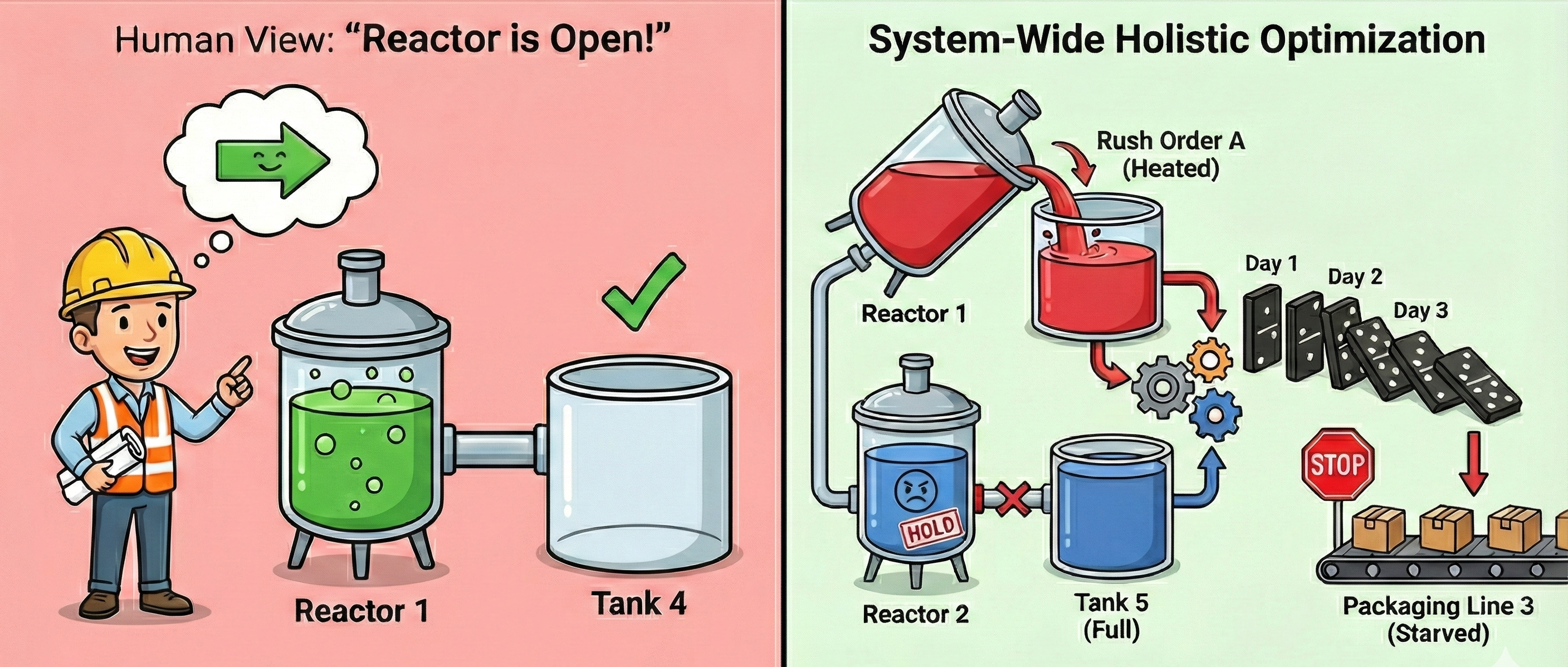
Discover how complex chemical processing plants can unlock hidden capacity by solving the sequencing problem. Learn how optimization prevents the domino effect of local decisions that starve downstream operations.
Your best planners are experts at keeping the reactors running today. But can they calculate how a decision made this morning will starve a packaging line three days from now? In complex chemical processing, the bottleneck isn't always equipment speed—it's the interaction between stages over time. This is where human intuition hits a mathematical wall.
Consider a common scenario: You have a rush order for Product A. Your planner looks at the schedule: Reactor 1 is open. The raw materials are available. The changeover is minimal. A human planner greenlights the run. It looks like an efficiency win. But this decision can silently destroy plant capacity later in the week.
Here is what the human planner couldn't see (because the calculation is too complex to simulate mentally):
Key Point: The planner "saved" the rush order but unwittingly sacrificed total plant throughput.
While a human planner looks for an open slot, the WonForge engine simulates the entire financial and operational flow. In this same scenario, the engine doesn't simply say "yes" or "no." It weighs the total economic impact:
Key Point: It doesn't rely on hope. It ensures the decision is based on math, not a blind spot.
We aren't replacing your planner's expertise; we are elevating it. While a human focuses on specific units or days, WonForge solves the entire operation holistically. It treats your reactors, tanks, and packaging lines as a single, unified system, ensuring that local efficiencies never come at the cost of global profitability.
If your plant suffers from "mystery downtime"—stops that happen because a tank was full or a line was starved—you don't have a capacity problem. You have a sequencing problem. Let's discuss how optimization can stop the domino effect before it starts.
Chemical manufacturing recipe optimization guide: Learn how process manufacturing companies increase asset utilization 12-20% and reduce working capital with advanced recipe modeling and campaign scheduling software.
Chemical manufacturing executives face a critical question: Is your production plan maximizing profitability, or just making everything fit? While your team manages complex recipes, by-products, and campaigns, traditional ERP and spreadsheet planning often delivers feasible plans—not optimal ones. The gap between 'feasible' and 'optimal' can cost chemical companies 6-12% in potential margin improvement.
Every manufacturer has a recipe defining what goes into each product. But in process industries like chemicals, coatings, and specialty materials, a recipe is more than an ingredient list. It's the digital fingerprint of how your plant actually runs — how raw materials flow, what by-products emerge, and how campaigns are sequenced to balance throughput, cost, and yield.
Key Point: Every suboptimal production decision directly impacts EBITDA and margin performance.
Traditional ERP and spreadsheet-based planning tools were built around static assumptions: fixed recipes, fixed yields, and fixed routings. But modern process manufacturing is dynamic. Each batch or campaign interacts with real-world variation — material properties, capacity limits, and market shifts.
Key Point: Plans that satisfy production constraints but miss margin opportunities — or create inefficiencies hidden in day-to-day operations.
Recipe optimization in chemical manufacturing is the process of using mathematical optimization solvers to automatically evaluate every aspect of production planning — demand patterns, recipes, routings, campaigns, yields, and constraints — to find the most profitable plan given actual business conditions.
Key Point: The solver doesn't just find a way to make everything fit — it balances economics, throughput, and customer demand simultaneously, producing a plan that is both executable and financially optimal.
Chemical companies implementing optimization-driven recipe modeling report significant improvements across key metrics:
Key Point: These improvements translate directly to measurable margin gains and improved financial performance.
WonForge is built around a flexible decision engine designed for complex, process-oriented manufacturing environments. Its strength lies in representing how recipes, campaigns, and capacities actually behave — not how they're simplified in spreadsheets.
Key Point: The result is a dynamic operational model of your manufacturing network — one that adapts to changes in demand, feedstock, or capacity and automatically recalculates the optimal plan.
Because the question isn't whether your planners can make the plan work — the real question is: can your system prove that it's the best plan? For chemical manufacturing executives ready to maximize profitability through advanced recipe modeling, schedule a strategic assessment to see how optimization-driven recipe modeling could improve your margins and asset utilization.
Recent global disruptions have made one thing clear: survival depends on supply chain resilience. For complex operations—especially in the chemical, food & beverage, and process industries—manual planning simply cannot cope with volatility. Optimization models provide the analytical firepower needed to build genuine flexibility and responsiveness into your network.
Recent global disruptions have made one thing clear: survival depends on supply chain resilience. For complex operations—especially in the chemical, food & beverage, and process industries—manual planning simply cannot cope with volatility. Optimization models provide the analytical firepower needed to build genuine flexibility and responsiveness into your network, enabling fast adaptation while protecting your profit margins.
Resilience isn't an accident; it must be designed into the system. Optimization models allow planners to incorporate real-world trade-offs and constraints, ensuring your plans remain viable even when things go sideways.
Key Point: Optimization models allow planners to incorporate real-world trade-offs and constraints, ensuring your plans remain viable even when things go sideways.
When a major disruption hits—be it a facility breakdown or a sudden spike in demand—the critical difference is the speed of your replan. Automated optimization systems can run thousands of scenarios and generate a robust, executable plan in minutes, not days.
Key Point: This ability to run rapid calculations is where modern solutions using high-speed solvers truly separate themselves from legacy systems.
Optimization is the ultimate "What-If" engine. It allows your team to rigorously stress-test the supply chain before a crisis, turning hidden risks into defined contingency plans.
Key Point: Optimization allows your team to rigorously stress-test the supply chain before a crisis, turning hidden risks into defined contingency plans.
Long-term resilience requires a system that learns and evolves. An effective optimization model is never static; it's constantly improving its own constraints and inputs.
Key Point: An effective optimization model is never static; it's constantly improving its own constraints and inputs.
Optimization models provide the foundation for adaptive, resilient supply chains, but implementing them often feels inaccessible due to complexity and high cost. WonForge is built to solve the resilience problem for complex production environments (chemical, food & beverage, process) by providing advanced analytical power and measurable operational improvements. We deliver the analytical foundation required for flexibility, real-time response, and scenario planning by accurately modeling your complex production constraints. Our goal is to translate this analytical power into quantifiable results, including typical improvements of 200–500% ROI, 90% reduction in planning time, and 10–20% improvement in service levels. WonForge gives companies the high-end analytical capabilities necessary to secure their production lines, turning operational resilience into a measurable competitive advantage.
Spreadsheets have long been the backbone of production and supply chain planning. They're flexible, familiar, and inexpensive — but as operations scale, their limits become costly.
Despite the rise of advanced planning systems, over 70% of manufacturing companies still rely primarily on spreadsheets for production planning. They're flexible, familiar, and inexpensive — but as operations scale, their limits become costly. Anyone who's tried managing hundreds of SKUs or multiple lines in Excel has seen it firsthand: manual planning simply can't keep up with real-world complexity.
Spreadsheets can store production rates, inventory targets, and forecasts — but they can't decide how to balance them. Once the number of products, lines, and constraints grows, manual adjustments turn into guesswork.
Key Point: Optimization models evaluate millions of possibilities instantly to find the best plan under all constraints — something no spreadsheet can achieve.
Manufacturing isn't just math. Real planning involves setup times, shared equipment, batch rules, and material dependencies — all changing daily. Spreadsheets rely on human memory and fragile formulas to maintain these relationships. One broken formula can derail an entire week's plan.
Key Point: Optimization models handle these constraints natively, ensuring every plan is both feasible and efficient.
Good planning is about trade-offs. A planner might ask:
Key Point: In spreadsheets, exploring each "what-if" means copying and rebuilding the model. Optimization models simulate these scenarios instantly, showing how every decision affects cost, utilization, and service — empowering planners to make faster, smarter decisions.
Production data changes constantly — new orders, machine downtime, material delays. Spreadsheets can't adapt in real time. By the time one version is finalized, the situation has already changed.
Key Point: Automated optimization models can re-optimize multiple times per day, integrating live data and generating updated schedules in minutes.
Even the most carefully built spreadsheets contain mistakes. Studies show over 80% of complex spreadsheets include at least one serious error. In manufacturing, those errors lead to costly consequences — excess inventory, missed shipments, and unnecessary overtime.
Key Point: Optimization models eliminate this risk by replacing manual formulas with consistent, traceable, and auditable logic.
Traditional planning cycles often take days or even weeks to finalize. That delay creates missed opportunities, inefficient resource use, and higher operating costs. Meanwhile, manual planning burns valuable talent — planners spend most of their time fixing data, reconciling files, and updating spreadsheets instead of analyzing and improving operations.
Key Point: Optimization models compress the planning cycle from days to hours, allowing planners to react immediately to changing conditions. More importantly, automation frees them from repetitive data work, letting them focus on strategy, risk management, and process improvement — the work that actually drives business performance.
The limitations of spreadsheets aren't theoretical — they're costing manufacturers real money every day through errors, delays, and missed opportunities. But moving to optimization doesn't have to mean a massive upfront investment or lengthy implementation. With WonForge, you can prove the value of optimization before committing to a full-scale deployment. Your first optimization model is developed with no upfront implementation fee and only minimal infrastructure cost during the initial phase. This proof-first approach lets you see real improvements — typically 200–500% ROI within the first year, up to 90% reduction in planning time, and 10–20% improvement in service levels — before making a full financial commitment. Because WonForge starts light, every efficiency gain flows directly to your bottom line.
Modern supply chain and operations systems often claim to use AI or machine learning for everything from forecasting to scheduling. But not all problems are created equal — and not every business question should be answered with a machine-learning model.
Modern supply chain and operations systems often claim to use AI or machine learning for everything from forecasting to scheduling. But not all problems are created equal — and not every business question should be answered with a machine-learning model. Optimization and ML are complementary tools that solve different kinds of problems. Knowing when to use each is the key to designing an effective planning system.
Machine learning is best suited for prediction — discovering relationships hidden in historical data.
Key Point: ML finds patterns in data — but it doesn't decide what to do next. It tells you what's likely, not what's optimal.
Optimization is about prescription, not prediction. It takes data (including ML forecasts) and identifies the best decisions under constraints.
Key Point: Optimization handles trade-offs and finds the best solution under constraints — something ML cannot do.
In real systems, the two often operate in sequence:
Key Point: Together, they turn uncertainty into action: ML provides insight; optimization delivers the plan.
If the goal is to understand or forecast behavior, use machine learning. If the goal is to make a decision under constraints, use optimization.
Key Point: Most advanced planning solutions — including those built by WonForge — use both, but optimization remains the decision engine that drives measurable results.
Explore our use cases and insights to learn how optimization can transform your business
Latest insights and thought leadership on optimization, analytics, and manufacturing excellence.

Your best planners are experts at keeping the reactors running today. But can they calculate how a decision made this morning will starve a packaging line three days from now? In complex chemical processing, the bottleneck isn't always equipment speed—it's the interaction between stages over time. This is where human intuition hits a mathematical wall.
Consider a common scenario: You have a rush order for Product A. Your planner looks at the schedule: Reactor 1 is open. The raw materials are available. The changeover is minimal. A human planner greenlights the run. It looks like an efficiency win. But this decision can silently destroy plant capacity later in the week.
Here is what the human planner couldn't see (because the calculation is too complex to simulate mentally):
The planner "saved" the rush order but unwittingly sacrificed total plant throughput.
While a human planner looks for an open slot, the WonForge engine simulates the entire financial and operational flow. In this same scenario, the engine doesn't simply say "yes" or "no." It weighs the total economic impact:
It doesn't rely on hope. It ensures the decision is based on math, not a blind spot.
We aren't replacing your planner's expertise; we are elevating it. While a human focuses on specific units or days, WonForge solves the entire operation holistically. It treats your reactors, tanks, and packaging lines as a single, unified system, ensuring that local efficiencies never come at the cost of global profitability.
If your plant suffers from "mystery downtime"—stops that happen because a tank was full or a line was starved—you don't have a capacity problem. You have a sequencing problem. Let's discuss how optimization can stop the domino effect before it starts.
Discover how WonForge turns your unique constraints into improved margins and a competitive advantage.