Insights & Use Cases
Explore our use cases and insights to learn how optimization can transform your business
Insights
Latest insights and thought leadership on optimization, analytics, and manufacturing excellence.
Multi-Echelon Inventory: Cutting Working Capital Without Cutting Service
Introduction
Every supply chain meeting involves a difficult conflict. Sales wants 100% on-shelf availability. Finance wants to slash working capital. Operations is stuck in the middle, usually resolving the issue by holding excess inventory "just in case." But in multi-stage networks—especially in chemical and food & beverage processing—this "just in case" inventory accumulates at every single node. This traps millions of dollars in cash that could be used elsewhere in the business—often without actually guaranteeing the service levels that Sales demands.
1. The "Siloed Safety Stock" Trap
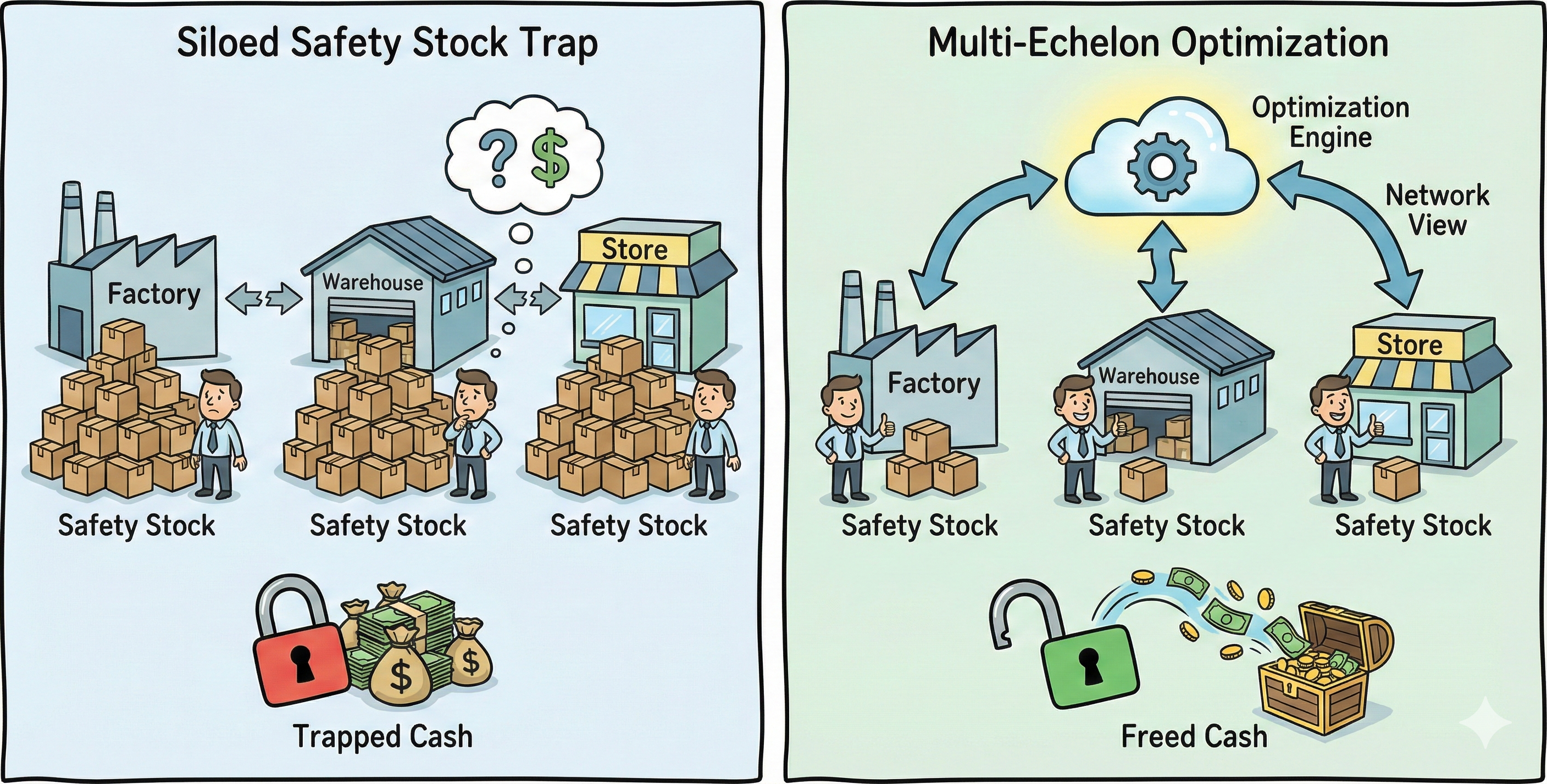
Most organizations calculate safety stock using standard textbook formulas applied to each location independently. The Plant ensures they have enough stock to feed the Central DC. The Central DC buffers stock to feed the Regional Warehouses. The Regional Warehouse buffers stock to service the customer.
When every node buffers against the variability of the node before it, you create a static version of the bullwhip effect. Instead of amplifying demand signals, you are amplifying inventory buffers. You are essentially paying to insure the same risk multiple times across the network. Crucially, this approach also obscures real risks; while one warehouse sits on excess stock, another might be starving, leading to stockouts despite high total network inventory.
2. Moving from Local to Network Optimization
Multi-Echelon Inventory Optimization (MEIO) changes the math. Instead of looking at one warehouse at a time, the WonForge engine looks at the entire chain simultaneously. It asks: "Where is the cheapest and most effective place to hold this safety stock to guarantee our service targets?" By shifting the perspective, the engine identifies opportunities to simultaneously reduce inventory and improve availability that traditional planning methods miss:
- Risk Pooling: If the Central DC is highly reliable, the Regional Warehouses can carry significantly less safety stock without risking stockouts.
- Postponement: It may be optimal to keep inventory in a semi-finished (bulk) state longer, only packaging it when demand is confirmed. This reduces the risk of having too much of the wrong SKU and not enough of the right one.
- Lead Time Sensitivity: It identifies which nodes actually require rapid response versus which can tolerate replenishment delays.
The engine identifies opportunities to simultaneously reduce inventory and improve availability.
3. The Perishability Factor
For WonForge clients in the food & beverage and chemical sectors, excess inventory isn't just a cash flow problem—it's a waste problem. Holding high safety stock in a siloed manner increases the risk of product expiring before it reaches the customer.
WonForge's decision engine incorporates shelf-life constraints directly into the inventory model. We calculate the "freshness risk" of every stocking decision, ensuring that aggressive safety stock targets don't result in aggressive write-offs.
4. The Financial Impact
By transitioning from sequential planning to multi-echelon optimization, companies typically see a reduction in total network inventory of 15–30%—often while actually improving on-shelf availability. In a high-volume chemical business, this often represents enough released cash to fund a new production line or cover the entire R&D budget for the year.
Multi-echelon optimization releases working capital that can be reinvested in growth initiatives while maintaining or improving service levels.
Conclusion
If your inventory strategy is simply "days of supply" targets set on spreadsheets for each location, you are likely over-insured in some areas and exposed to shortages in others. WonForge moves you away from static targets. We use optimization to mathematically right-size your inventory layers, ensuring that every dollar of working capital is actually working for you. Let's discuss how we can keep your customers happy—and your CFO happier.
See What WonForge Finds in Your Data
Book a feasibility call to evaluate your planning challenges and see how custom optimization can protect your P&L.
Email: contact@wonforge.com
Based in Wilmington, DE, serving businesses across the U.S.