Insights & Use Cases
Explore our use cases and insights to learn how optimization can transform your business
Insights
Latest insights and thought leadership on optimization, analytics, and manufacturing excellence.
Is your Rework Tank a storage problem or a profit center?
Introduction
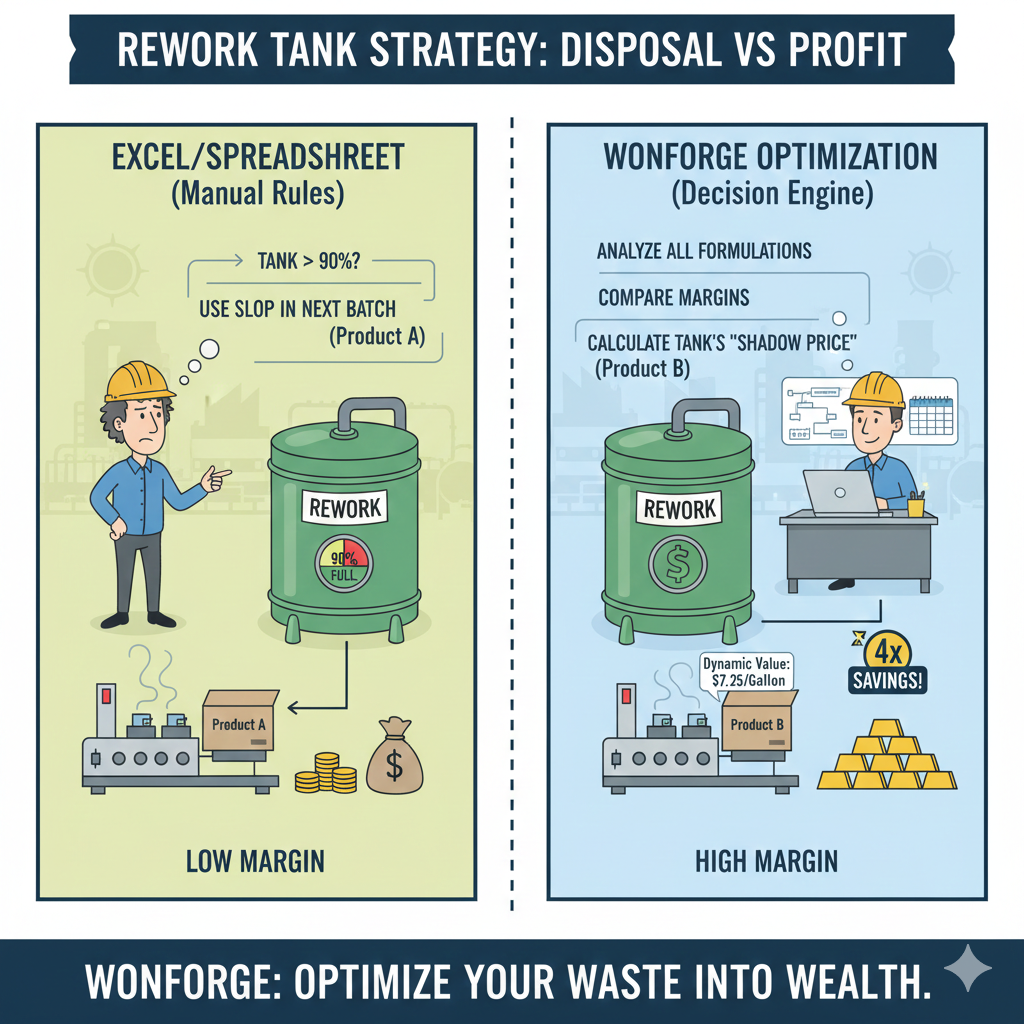
Every scheduler monitors the Rework (or 'Slop') tank. You know it represents potential margin, and you actively look for opportunities to blend it back in. But when you're managing 50 tanks and complex changeovers in a spreadsheet, you can't calculate the financial impact of every gallon across the horizon. The sheet forces you into a "First Feasible" rule: If the tank is getting full, put it in the next batch that allows it. That keeps the plant running, but it leaks margin. The difference between a "Good" schedule and an "Optimal" one isn't about using the rework—it's about when you use it. Here is how optimization shifts the logic from disposal to monetization:
1. "First Feasible" vs. "Most Profitable"
A spreadsheet can't evaluate margin per gallon across your full schedule. If Generic Product A is running tomorrow and allows 10% rework, the sheet (or the rule you encode in it) says use it to clear the tank. Product A uses cheap base stocks—replacing them saves you pennies. The optimized choice: The engine sees Premium Product B scheduled for Friday, which uses expensive synthetic raw materials. It calculates that holding the inventory for 3 days captures 4x the savings per gallon, justifying the storage cost.
- The Problem: Product A uses cheap base stocks. Replacing them saves you pennies.
- The Optimized Choice: Premium Product B uses expensive synthetic raw materials. Holding for 3 days captures 4x the savings per gallon, justifying the storage cost.
The engine holds rework for high-margin formulations when the math justifies it—turning storage from a problem into strategic leverage.
2. Finding the "Long Tail" Opportunities
Spreadsheets typically rely on a short list—a "Top 5" of formulations that allow rework—because scanning the full formulation library in Excel is impractical. But your technical database might contain 50 low-volume SKUs that are also valid candidates. WonForge scans the entire formulation library instantly. It identifies consumption opportunities in the "long tail" of your portfolio—obscure batches that relieve tank pressure without impacting your primary products.
WonForge scans the entire formulation library instantly, identifying long-tail opportunities that spreadsheets can't easily surface.
3. Storage as Strategic Leverage (The Shadow Price)
We don't use static safety rules like "Sell if > 90% full." Optimization treats tank capacity as a dynamic economic constraint. The engine calculates the precise value of your storage capacity dynamically. When tank pressure is low, the engine is "selective," holding out for high-margin formulations. As tank pressure rises, the "cost" of holding inventory increases mathematically, forcing the model to accept lower-margin options to protect the sequence.
It's a continuous sliding scale, not a rigid rule—storage is valued dynamically so every gallon goes to its most profitable home.
Conclusion
You are already doing the hard work of capturing and recycling flush. But by relying on spreadsheets and manual rules, you are likely consuming that valuable resource in the wrong products. WonForge adds the computational power to match your waste inventory to its most profitable home, ensuring every gallon of slop works as hard as possible for your bottom line.
See What WonForge Finds in Your Data
Book a feasibility call to evaluate your planning challenges and see how custom optimization can protect your P&L.
Email: contact@wonforge.com
Based in Wilmington, DE, serving businesses across the U.S.