Insights & Use Cases
Explore our use cases and insights to learn how optimization can transform your business
Insights
Latest insights and thought leadership on optimization, analytics, and manufacturing excellence.
How Optimization Delivers Operational Resilience
Introduction
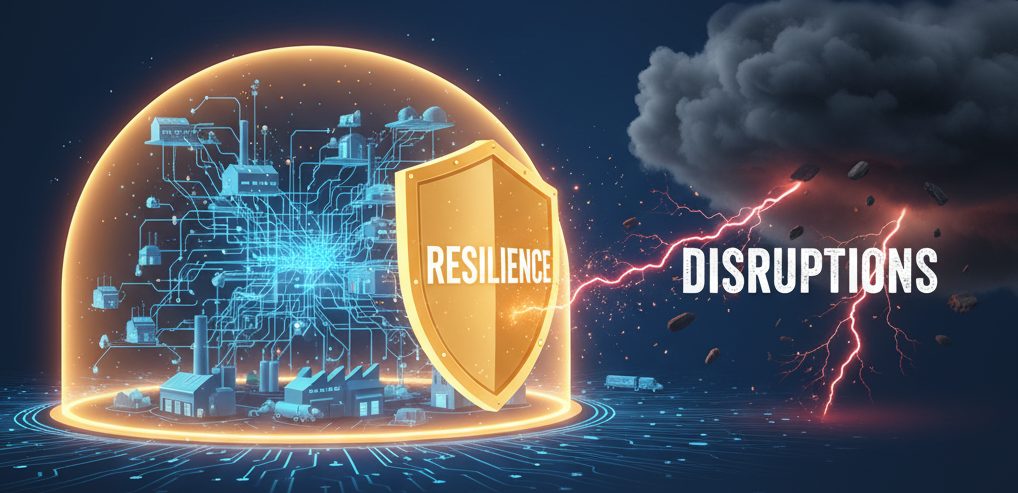
Recent global disruptions have made one thing clear: survival depends on supply chain resilience. For complex operations—especially in the chemical, food & beverage, and process industries—manual planning simply cannot cope with volatility. Optimization models provide the analytical firepower needed to build genuine flexibility and responsiveness into your network, enabling fast adaptation while protecting your profit margins.
1. Architecting the Flexible Network
Resilience isn't an accident; it must be designed into the system. Optimization models allow planners to incorporate real-world trade-offs and constraints, ensuring your plans remain viable even when things go sideways.
- De-risking Single Sourcing: Evaluating the actual cost/benefit of multi-sourcing raw materials to reduce critical supplier dependency (a necessity when dealing with volatile inputs).
- Flexible Production Changeovers: Modeling flexible production lines that can quickly switch between recipes or product families, minimizing lost time.
- Strategic Buffer Stock: Optimizing the location and type of buffer inventory—not just how much—to shield final customers from upstream delays (crucial for short shelf-life items).
- Alternative Routes: Pre-planning alternative transportation methods and routes to bypass logistics bottlenecks.
Optimization models allow planners to incorporate real-world trade-offs and constraints, ensuring your plans remain viable even when things go sideways.
2. The Power of Real-Time Response
When a major disruption hits—be it a facility breakdown or a sudden spike in demand—the critical difference is the speed of your replan. Automated optimization systems can run thousands of scenarios and generate a robust, executable plan in minutes, not days.
- Instant Capacity Reallocation: Rapidly re-routing high-priority orders to alternative lines when a production asset fails, automatically balancing cost and service level.
- Dynamic Routing & Delivery: Generating instantaneous adjustments to trucking or vessel routes when port or traffic disruptions occur.
- Inventory Rebalancing: Quickly evaluating and moving the right inventory (especially specialized inputs) across distribution centers to meet revised demand or production needs.
This ability to run rapid calculations is where modern solutions using high-speed solvers truly separate themselves from legacy systems.
3. Rigorous Scenario Analysis and Stress Testing
Optimization is the ultimate "What-If" engine. It allows your team to rigorously stress-test the supply chain before a crisis, turning hidden risks into defined contingency plans.
- Supplier Failure Modeling: Quantifying the total impact of a top-tier supplier going down and validating the effectiveness of your pre-defined backup plans.
- Demand Volatility Scenarios: Stress-testing capacity against severe demand surge or collapse and identifying the labor and inventory limits under those conditions.
- Cost of Resilience: Evaluating the precise cost premium (e.g., in inventory or CapEx) required to achieve a target level of operational resilience.
Optimization allows your team to rigorously stress-test the supply chain before a crisis, turning hidden risks into defined contingency plans.
4. Continuous Adaptiveness and Learning
Long-term resilience requires a system that learns and evolves. An effective optimization model is never static; it's constantly improving its own constraints and inputs.
- Forecasting Integration: Seamlessly integrating machine learning outputs for better demand and lead-time forecasts directly into the optimization constraints.
- Adaptive Constraints: Automatically adjusting model parameters based on continuous real-world performance feedback (e.g., tightening the safety stock requirement when supplier performance has been excellent).
- Operationalizing Learnings: Using every disruption event to immediately update and improve the model's structure for the next run.
An effective optimization model is never static; it's constantly improving its own constraints and inputs.
Conclusion
Optimization models provide the foundation for adaptive, resilient supply chains, but implementing them often feels inaccessible due to complexity and high cost. WonForge is built to solve the resilience problem for complex production environments (chemical, food & beverage, process) by providing advanced analytical power and measurable operational improvements. We deliver the analytical foundation required for flexibility, real-time response, and scenario planning by accurately modeling your complex production constraints. Our goal is to translate this analytical power into quantifiable results, including typical improvements of 200–500% ROI, 90% reduction in planning time, and 10–20% improvement in service levels. WonForge gives companies the high-end analytical capabilities necessary to secure their production lines, turning operational resilience into a measurable competitive advantage.
See What WonForge Finds in Your Data
Book a feasibility call to evaluate your planning challenges and see how custom optimization can protect your P&L.
Email: contact@wonforge.com
Based in Wilmington, DE, serving businesses across the U.S.